Close, But Not Case-Closed
A courtroom test of the method behind wallet labelling
When funds move into or out of a crypto wallet, a court's core question is less technical than you might think. It comes from the same test required since the law of evidence began: how anyone knows what they claim to know. A tracing report can look thorough yet rest on shaky ground built on a source that sounds authoritative but cannot survive cross-examination. The next, more important question is: will your data hold up under similar testing?
This question lies at the heart of several major crypto lawsuits in English courts today. These cases involve urgent freezing orders, global asset searches, and decisions about returning money to victims. Over the past two years, three cases tested this idea and reached different outcomes. The key factor was not the tracing software but whether the person doing the tracing could clearly explain their work to the judge.
Labels: no more than leads
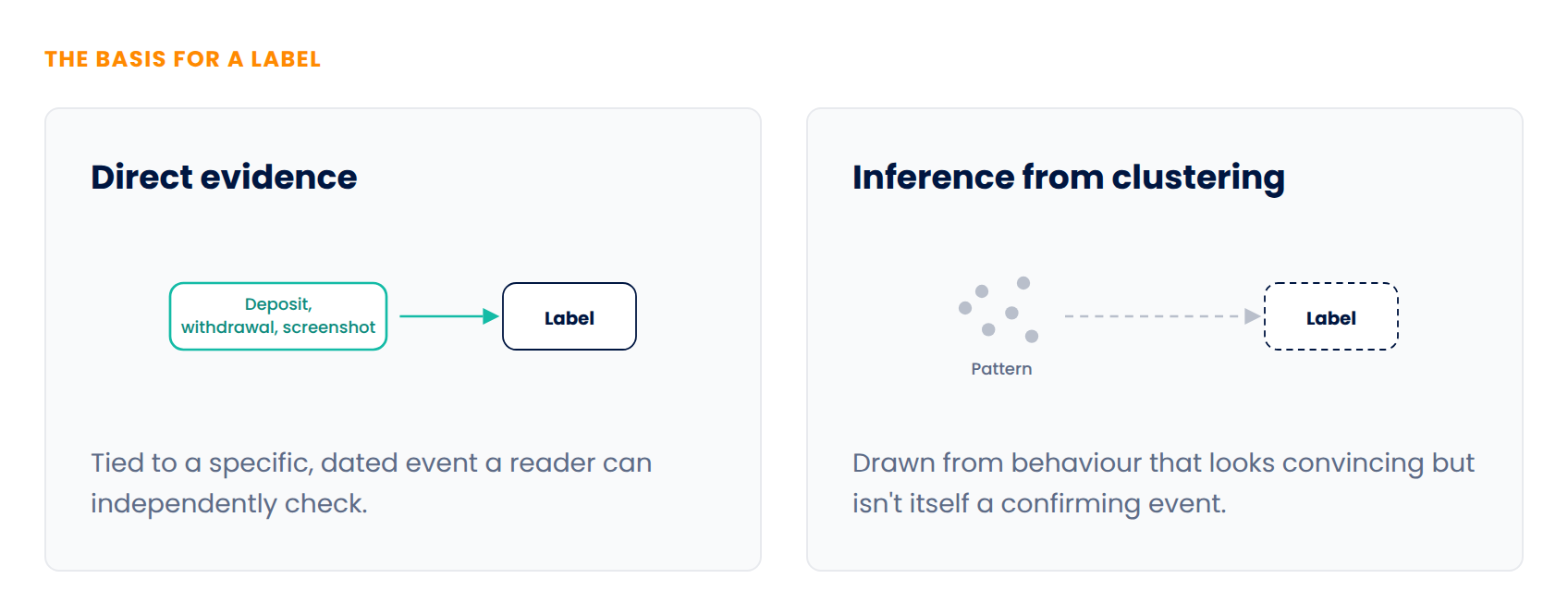
A label such as 'exchange wallet' or 'linked to this address' is a solid start. It gives you a name but not how anyone knows it, when it was confirmed, or if it is based on direct evidence or assumption. Digital asset attribution is rated based on supporting evidence. Direct evidence, like a recorded deposit or confirmed withdrawal, differs from an inference based on patterns, no matter how convincing they look. Some come from clear proof like a recorded deposit, confirmed withdrawal, or a screenshot from that time. Others depend on patterns that look convincing but prove nothing on their own.
Lessons from the docket: D'Aloia, Jones and Wilden
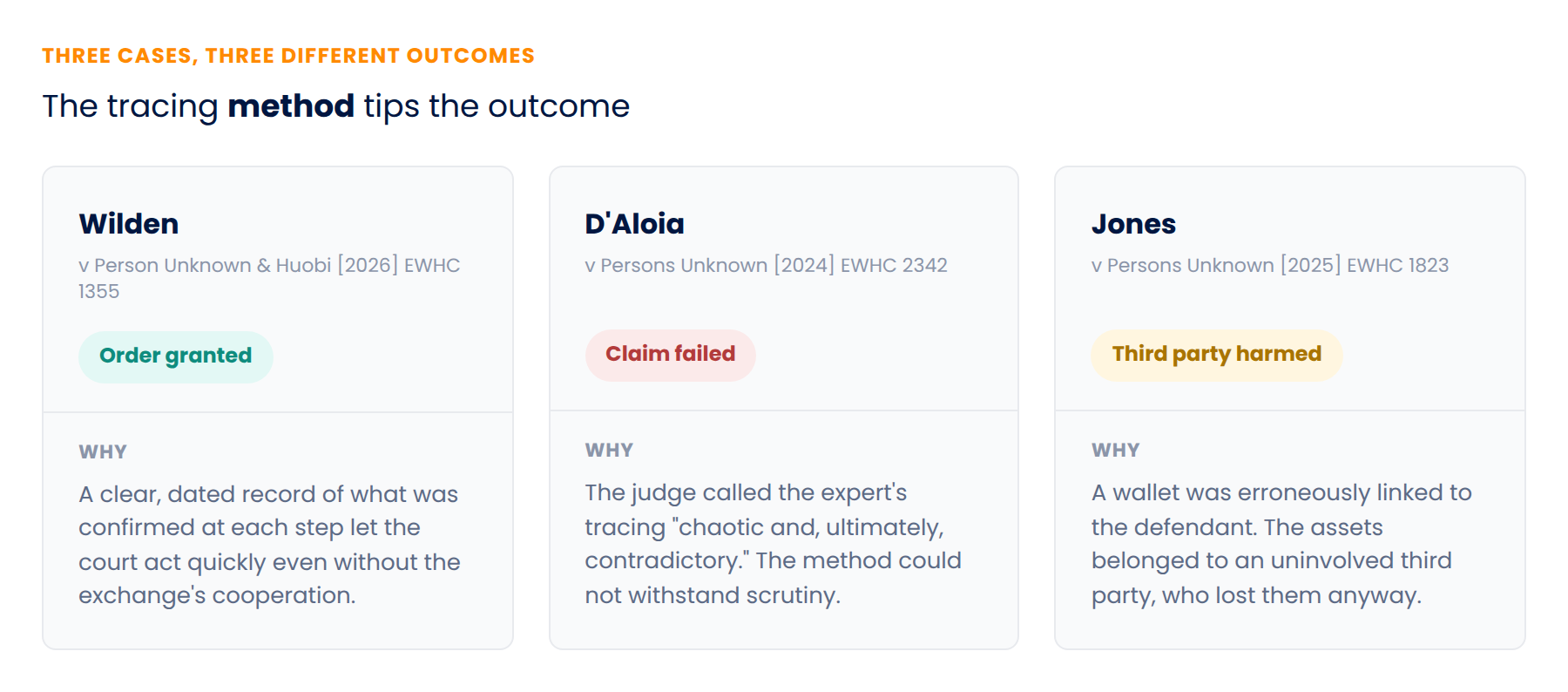
Wilden v Person Unknown & Huobi [2026] EWHC 1355
A victim lost around €2.6 million (32.46 BTC) in a recovery scam. On 17 March 2026, the High Court issued a proprietary and worldwide freezing order, along with a disclosure order against the exchange, even though the exchange did not cooperate.
This is the result lawyers hope for: an order against unknown people, a freezing injunction, and a disclosure order that holds up even if the other side does not cooperate. It worked because the tracing was reliable. A clear record of what was confirmed at each step helps the court act quickly.
D'Aloia v Persons Unknown [2024] EWHC 2342
The claim against the exchange Bitkub failed after a full trial. The judge found the expert's tracing "chaotic and, ultimately, contradictory," and described the process as "driven by the system as opposed to the expert."
This case often appears in crypto attribution examples. Even an expensive tool did not help the claimant. The real problem was that the expert could not explain their method when it mattered. Evidence from a system without clear reasoning from the user does not stand up in court. A repeatable method, with each step shown, dated, and checked, survives tough questions. What the tool says is important; however, knowing why it is correct can make all the difference.
Jones v Persons Unknown [2025] EWHC 1823
Expert evidence traced stolen BTC to a Huobi wallet. However, the assets in that wallet did not belong to the defendant. Instead, they belonged to Kyrrex and other third parties, yet the court still used them to satisfy the judgment. Kyrrex unsuccessfully appealed the decision.
This case shows how an incorrect label does more than damage a case; it can harm someone not involved. Investigators must give the court full and accurate information when applying without notice. Showing how confident you are in an attribution — and where it might be wrong — is not just helpful; it can be the only thing protecting an innocent third party from losing access to their money.
The Reckoning
These three cases ended differently but share a common thread: whether one could show, date, and defend the method behind the label under scrutiny. What separates a label that "sounds right" from one that is court-ready is whether your source can go beyond a name and provide a more complete evidentiary picture.
The Chainlabs Standard
A label is only as good as the evidence behind it. An estimated 90% of the KYT market runs on Chainlabs data—the attribution layer beneath the transaction monitoring tools that investigators already trust. That depth comes from how we build it: each attributed wallet is tied to the evidence that supports it — whether that's direct evidence or an inference from clustering — and when it was confirmed. Every attribution passes a quality check before it reaches a client.
Delivered as an MCP server, this lets investigators query our entity data from inside their own AI tools and get back a name they can trust. When needed, they can access the provenance behind it: the difference between a lead and something you can defend in front of a judge.
Research & Technical: Greg Schneider
Editorial: Scott Mallen