Gambling on Incomplete Data
When partial attribution falls short
"The fool doth think he is wise, but the wise man knows himself to be a fool." ~ Shakespeare, As You Like It
Crypto-enabled gambling has moved from a niche use case to a large and fast-growing segment, now generating tens of billions in revenue. Growth on this scale leads to a profound reordering: users and platforms are increasingly bypassing traditional banking and geographic constraints in favour of crypto-native infrastructure that is faster, more accessible, and harder to restrict.
The infrastructure underpinning online gambling platforms often remains complex and opaque. Rather than operating through a single set of wallets, these platforms typically split activity across multiple address types such as deposits, gameplay wallets, treasury management and withdrawals, often across chains. Funds can move between chains to manage liquidity or routing and are frequently intermixed with third-party services such as payment processors or exchange infrastructure.
On top of this, user activity introduces additional layers of complexity. Deposits are not immediately withdrawn but pass through betting cycles, internal balances and delayed withdrawal mechanisms, making it difficult to link inflows to outflows directly. Many operators also reuse infrastructure across multiple brands or domains, further blurring entity boundaries. Taken together, this results in fragmented and non-linear fund flows where a single user journey can span multiple wallets, chains and operational layers, making attribution and risk assessment significantly more challenging.
For exchanges and compliance teams interacting with the gambling sector, this creates a persistent trade-off: identifying illicit activity while maintaining access to legitimate flows. Flag too aggressively, and you risk blocking legitimate, high-value activity; too conservatively, and you increase exposure to fraud, sanctions, or illicit flows. In practice, this is not a theoretical problem — it directly affects how usable and reliable risk signals are in day-to-day operations.
Most attribution methods rely on labels, identifying known addresses and assigning them to entities. While useful, stopping at the label limits visibility to isolated points rather than connected activity, leaving gaps in understanding how entities operate, how funds move, where infrastructure overlaps, and how activity evolves over time. The difference between a label and a cluster is simple: one tells you what something is called, the other shows you how it works.
At Chainlabs, we approach this differently. Rather than relying only on existing labels, we trace gambling entities from the ground up by directly interacting with platforms and capturing real on-chain behaviour across Bitcoin, Ethereum, Tron, Solana, and others. This includes executing deposits, observing gameplay flows, and tracking withdrawals to understand how activity unfolds across the system. From there, we expand seed data into clusters, turning each entity into a gateway to wallet infrastructure, cross-chain activity, and operational patterns. This shifts the focus beyond static attribution to real activity: identifying where funds land, but understanding where they go next and how they unfold across the broader ecosystem.
A common challenge in attribution is dealing with addresses that initially appear relevant but lead to little or no usable activity. Instead of discarding these early, our analysts apply iterative retracing techniques, identifying low-quality indicators early, revisiting incomplete traces and continuously refreshing data as new activity emerges. This allows us to recover value from partial signals and expand coverage over time, particularly in cases where activity is delayed, fragmented or cross-chain.
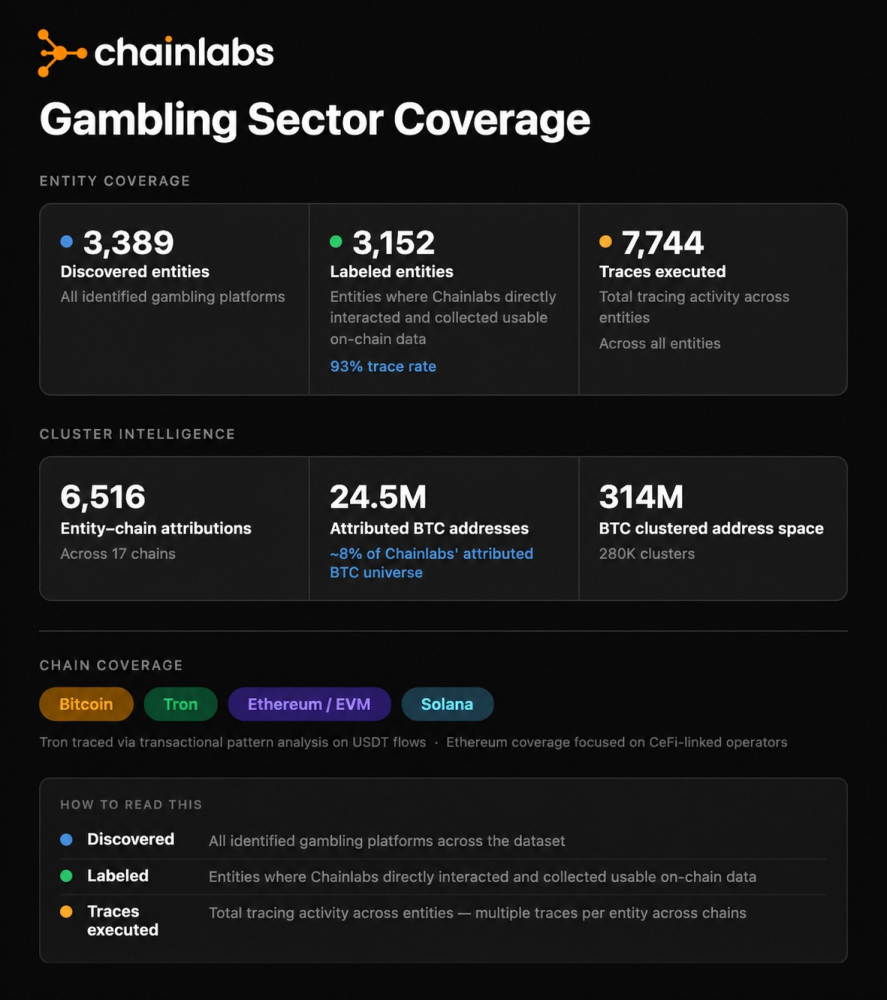
Today, Chainlabs' gambling dataset covers 3,389 entities across 17 chains, with 6,516 entity-chain attributions reflecting multi-chain operators (see infographic below). By combining broad coverage with continuous discovery, clients can move beyond isolated data points to understand how entities connect, interact, and unfold across chains. Instead of a collection of static points, this reveals a full network of connections, pathways, and hidden routes that show how the ecosystem is authentically configured.
Technical: Rhea Klansek & Dimitar Chaushev Data: Guillaume Donnet
Editorial: Scott Mallen
Chainlabs Reports An ongoing series covering entity typologies, risk infrastructure, and on-chain intelligence across high-complexity sectors.
Chainlabs Know who is behind digital asset flows