Russia's Crypto Rails
Sanctions risk moves upstream
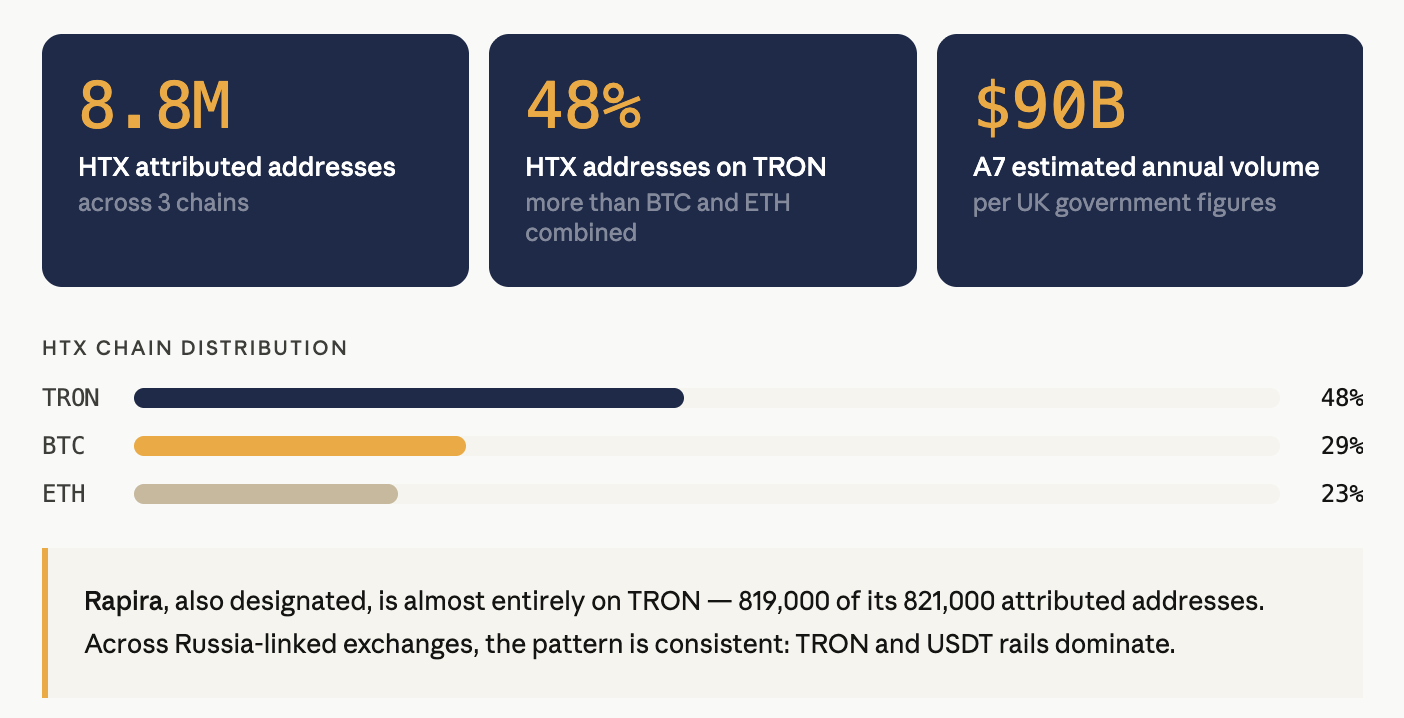
Late last month, the UK FCDO added 18 entities to its Russia sanctions list. Among them: HTX, EXMO, Rapira, Aifory, and Bitpapa. All five of these entities were already labelled in our system.
The HTX designation is a single data point, while the on-chain cluster is much bigger. Exposure extends far beyond HTX to the wider network. A7A5 lets users swap into major stablecoins without identity checks, which is its main feature. Standard screening tools flag designated addresses but often miss the infrastructure that hides the connection before the swap. As a result, lists updated before 26 May (the day of designation) will not detect this activity. For HTX, the risk window is large. The UK government estimates A7’s yearly volume at $90 billion, which is more than the GDP of many countries that enforce these sanctions.
Looking Ahead
This is the first time Regulation 17A has been applied to a crypto exchange, bringing banking-grade restrictions, and we expect this precedent to extend to other exchanges. Historically, the UK, OFAC, and EU sanctions regimes have aligned. Thus, action by OFAC or the EU is likely to follow. Other jurisdictions have not yet moved; however, we anticipate that Russia-linked evasion flows will continue to flow through TRON, USDT rails, and bespoke ruble and stablecoin instruments.
Sanctions Risk Moves Upstream
The HTX designation shows that sanctions risk now starts earlier in the process. Simply screening named wallets after they are flagged is not enough. The real risk is in the infrastructure layer, including exchange clusters, payment rails, OTC networks, stablecoin pathways, ruble conversion methods, and counterparties that support sanctioned flows before they are officially identified.
This is where attribution-layer intelligence comes in. It maps out crypto infrastructure at the entity level before official lists are updated.
Editorial: Scott Mallen
Chainlabs Know who is behind digital asset flows