REPORTS
The Shape of DeFi (Part III)
Attributing by Actor
Read more
Tracing by Behaviour
Part II of III in The Shape of DeFi series. Read Part I: Mapping by Function and Part III: Attributing by Actor.
In short: One coordinated operation is behind most of the bridging by mixer recipients on Ethereum in summer 2026. Between early July and early September, 11,723 new addresses each took a single Tornado Cash withdrawal, sent everything to a layer 2 network about 48 seconds later, and the money returned to Ethereum. Counting it, 64.9% of mixer recipients bridged within 30 days and 7.2% used a DeFi protocol; set it aside and the figures are 24.8% and 15.5%. We don't know who is behind it or whether the funds are illicit, and we make no claim either way.
Between early July and early September 2026, 11,723 new addresses each received a single withdrawal from Tornado Cash, the best-known crypto mixer. About 48 seconds later (four Ethereum blocks), each sent everything to another network. On Arbitrum, 95% of those arrivals returned to Ethereum, half within 32 seconds.
Behind these addresses is a single coordinated operation, and it skews the figures below:
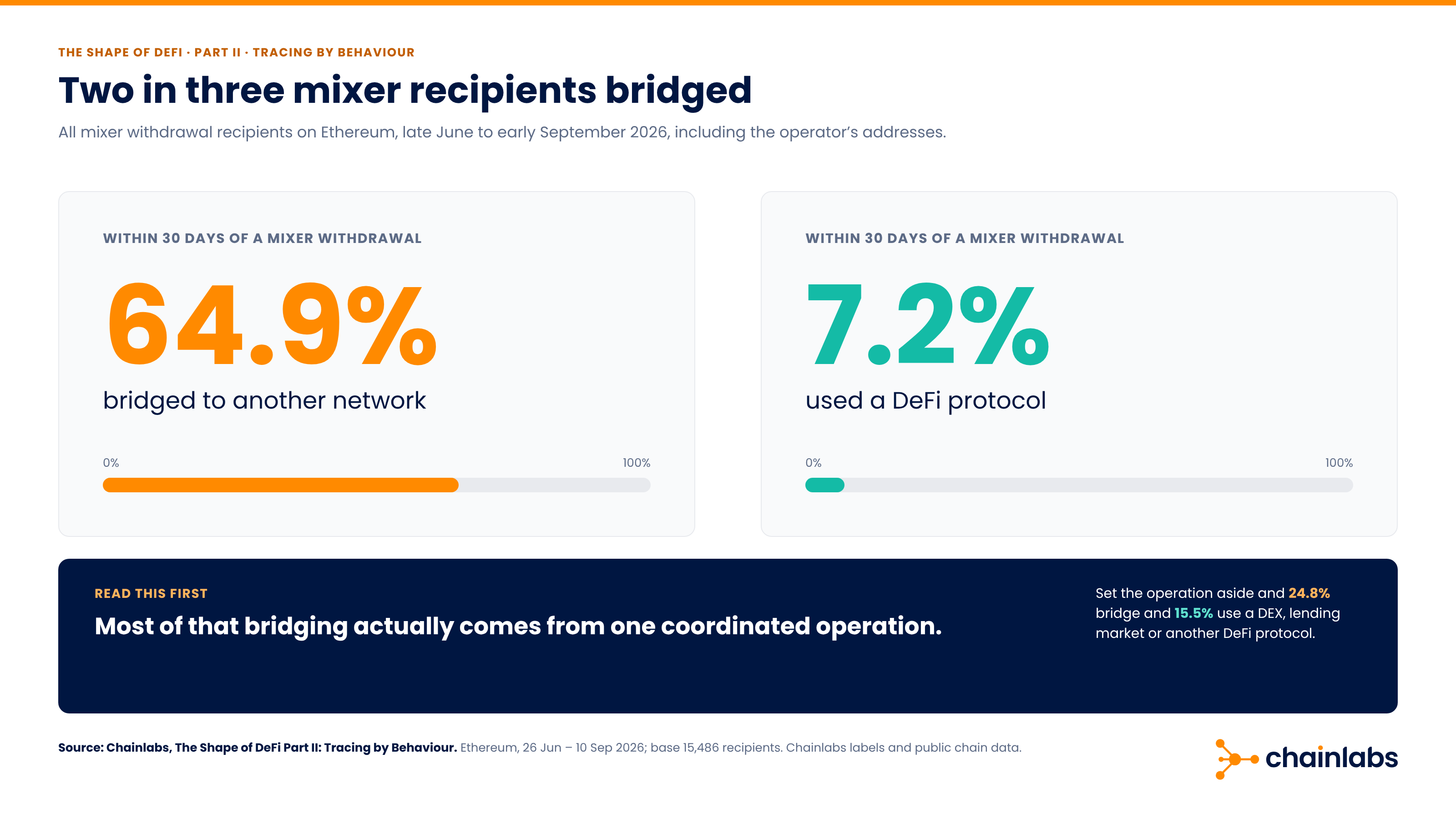
At first glance, mixer users seem to skip trading and lending and send funds straight to other networks. Most of that bridging actually comes from the coordinated operation described above.
A mixer pools funds from many users, breaking the visible link between deposit and withdrawal. Users deposit fixed amounts called notes. Layer 2 networks like Arbitrum, Optimism, and zkSync run on Ethereum and offer faster, cheaper transactions. Bridges move funds between these networks and Ethereum.
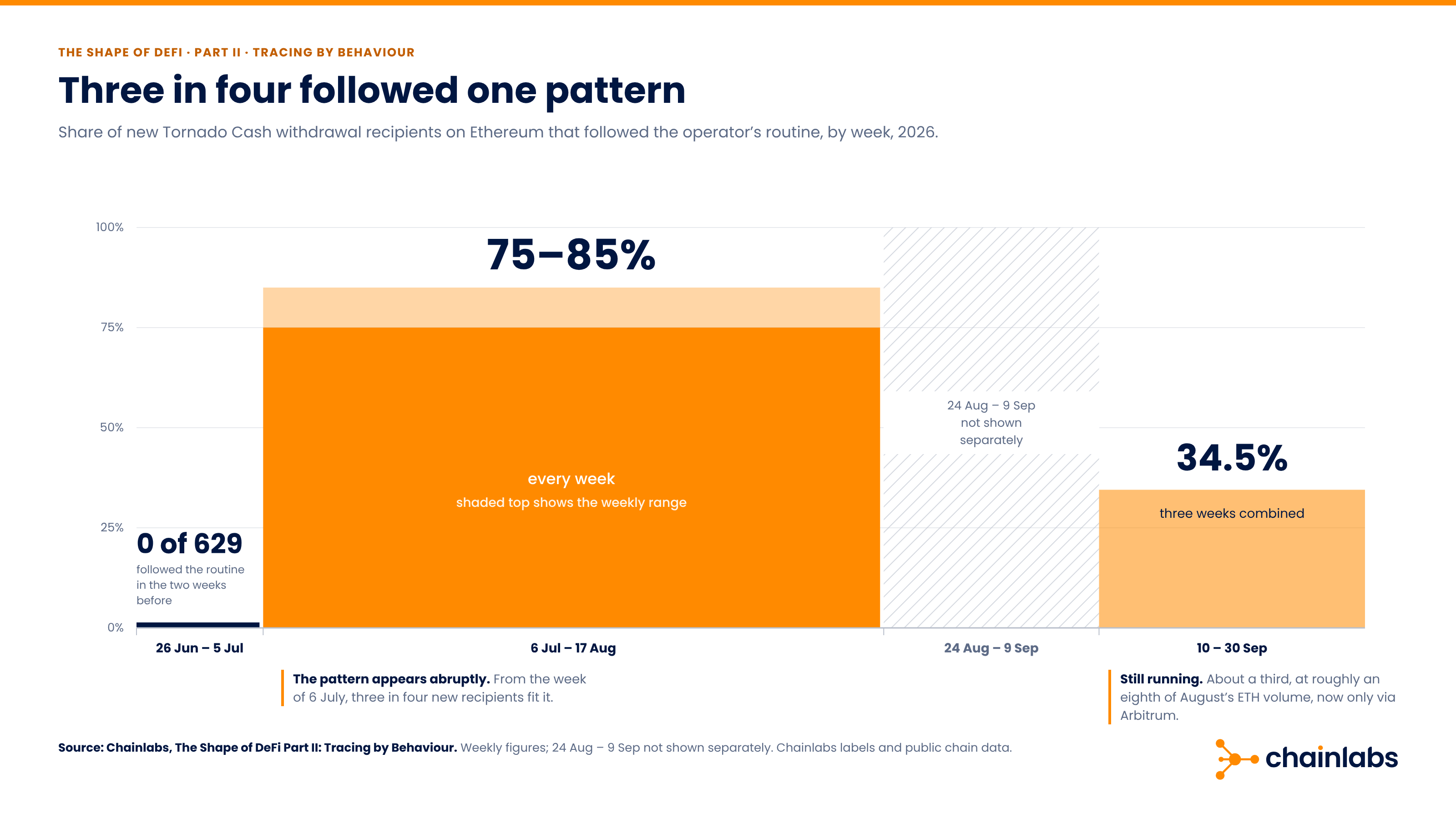
The pattern appears abruptly, in the week of 6 July. In the two weeks before, no new recipients followed this routine. From that week, three in four new recipients of Tornado Cash withdrawals on Ethereum fit this pattern.
We treat these addresses as one, so we call whoever runs them the operator. We don't know who is behind it or whether the funds are illicit, and we make no claim either way.
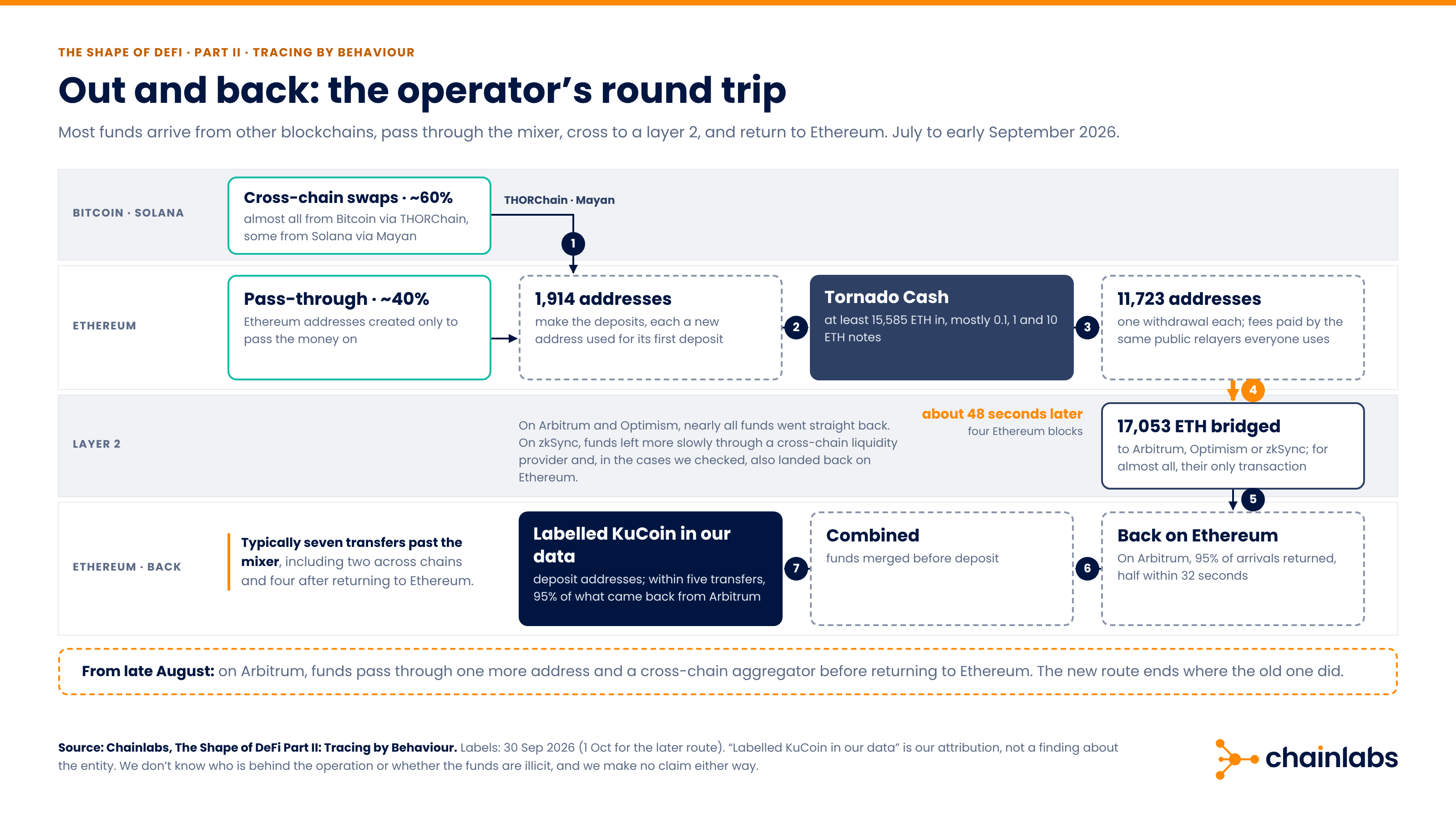
The route forms a loop: most funds arrive from other blockchains, pass through the mixer, cross to a layer 2, and return to Ethereum.
Roughly 60% of the ETH came in via cross-chain swaps, almost all from Bitcoin through THORChain and some from Solana through Mayan. The rest came from Ethereum addresses created only to pass the money on.
At least 15,585 ETH went in, mostly in 0.1, 1, and 10 ETH notes, from 1,914 addresses that made the deposits. Each was a new address used for its first deposit. The money went out to 11,723 new addresses, each with one withdrawal. The same public relayers (services that pay transaction fees on a user's behalf) that serve everyone else paid the fees.
Each address then sent everything to Arbitrum, Optimism, or zkSync, totalling 17,053 ETH. For almost all, this was their only transaction. On Arbitrum and Optimism, nearly all funds went straight back to Ethereum. On zkSync, funds left more slowly through a cross-chain liquidity provider and, in the cases we checked, also landed back on Ethereum.
Most of the money that came back from Arbitrum went to an exchange. Within five transfers, 95% reached deposit addresses our data labels as KuCoin (labels as of 30 September 2026).
By its habits. A mixer cannot hide those of an operation that repeats the same moves thousands of times. Deposits and withdrawals rise and fall together, about an hour apart. Everything points to two ends of the same operation: every deposit used the same unusual fee setting. In the smallest pool, other users hadn't deposited enough since June to cover the withdrawals, so the operator must have been funding its own. The mixer still hides which deposit paid which withdrawal.
None of this appears in a single transaction. The pattern emerges only when you view thousands of addresses across networks, with the services they touch labelled. That is the view Chainlabs' data is built to give.
"Look at any one of these transactions and nothing stands out. Put more than 11,000 addresses side by side, each bridging within a minute of its withdrawal, and you are looking at one operation," says Martín Jofré, Lead Analyst at Chainlabs.
Yes. Through September, about a third of addresses receiving Tornado Cash withdrawals on Ethereum still followed the same pattern, at roughly an eighth of August's ETH volume, now only via Arbitrum.
In late August, the route changed. On Arbitrum, funds pass through one more address and a cross-chain aggregator before returning to Ethereum. From mid-September, a single address took a 1% cut on nearly every transfer.
The new route ends where the old one did: back on Ethereum, combined, and into deposit addresses labelled KuCoin in our data (labels as of 1 October 2026), many of them the same addresses as in August.
Set that operation aside, and about a quarter of recipients bridge (24.8%), while about one in six use a DEX, lending market, or another DeFi protocol within 30 days (15.5%).
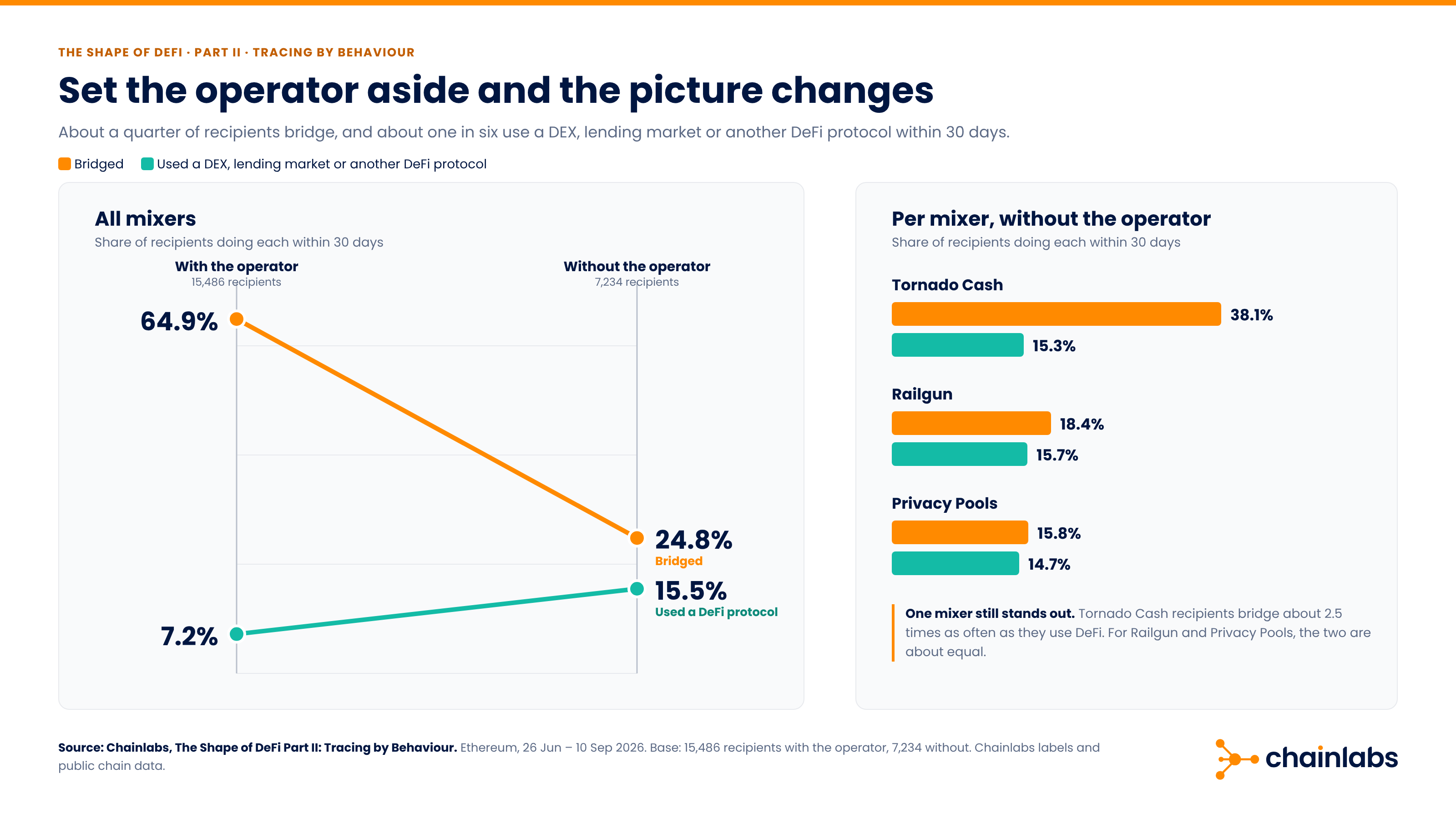
One mixer still stands out. Even without that operation, recipients of Tornado Cash withdrawals bridge about 2.5 times as often as they use a DEX, lending market, or another DeFi protocol. For Railgun and Privacy Pools, bridging and DeFi use are about equal.
Because one busy operator can look like a market-wide trend until you break the figure down. Part I showed that ranking DeFi by assets held misses what protocols actually do. Here in Part II, the same problem shows up inside a single statistic.
For anyone reading blockchain data, whether an analyst, a compliance team, or a journalist, the lesson is to identify the actor behind a pattern before drawing conclusions about the market. To see how this data can be used, visit our Solutions page.
In Part III, Attributing by Actor, we look at who is on the other side of the scam- and exploit-related volume that touches DeFi.
Where do funds go after leaving a mixer on Ethereum?
Across all the withdrawals analysed, after setting aside a single large operation, about a quarter of recipients bridged, and about one in six used a DEX, lending market, or another DeFi protocol within 30 days.
Why did so many mixer withdrawals go to bridges?
Mostly because of one operation. Starting the week of 6 July, three in four new recipients of Tornado Cash withdrawals on Ethereum belonged to it, and most sent their funds to a layer 2 network within a minute.
Can a mixer hide an operation like this?
Not fully. A mixer breaks the link between a deposit and a withdrawal, but repeated timing, identical behaviour, and shared collection addresses still show up across thousands of transactions.
Is the operation still running?
Yes. Through September, about a third of the addresses receiving Tornado Cash withdrawals on Ethereum still followed the pattern, at roughly an eighth of the August ETH volume, now only through Arbitrum.
The Shape of DeFi is a three-part series built on Chainlabs' internal taxonomy. Figures come from the Chainlabs catalogue and labels as of 30 September 2026.
Want to use this data in your own investigations? Book a call with our team.
Research & Data: Martín Jofré & Guillaume Donnet
Editorial: Scott Mallen